
Article | Source: Campus Sanofi · Read time: 3 minutes
Trust your senses: Smell matters more than you know
Author: Sanofi Editorial Team
Loss of smell is one of the most challenging symptoms of Chronic Nasal Polyps (Chronic Rhinosinusitis with Nasal Polyps, CRSwNP). It can affect how you enjoy food, connect with loved ones, and feel day to day. Losing your sense of smell can also be an early sign that your condition is getting worse or isn’t well controlled.1-3 Speaking with your doctor about getting a smell test and exploring treatment options can help you take control of your Chronic Nasal Polyps.4

Sense of smell is essential to everyday life
Your sense of smell is something most people take for granted.5,6 In fact, one in four people may not realize they have loss of smell until they are tested for it.7
But smell plays a bigger role in everyday life than you might think. It enhances the flavor of your favorite food and lets you enjoy familiar scents like flowers or fresh rain.8,9 Different scents can lift your spirits, stir up memories, and strengthen the bonds you share with loved ones.10 It also acts as a built-in safety system, helping you detect harmful things like spoiled food, gas leaks, or smoke from a fire.9,11
Losing your sense of smell (sinusitis loss of smell) can deeply affect what you eat and how much you enjoy food.1,5,11,12 It can also affect your emotional well-being, causing frustration, sadness and a feeling of disconnect from others.1,2,11,12
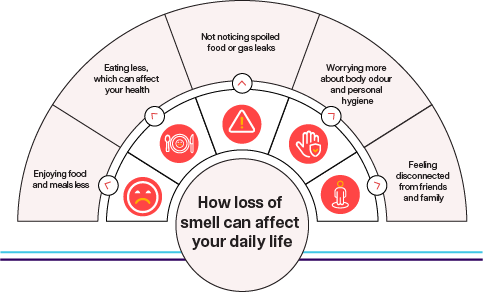
Loss of smell: More than missed scents
Losing your sense of smell isn’t just about missing scents, it can be a sign of Chronic Nasal Polyps (Chronic Rhinosinusitis with Nasal Polyps, CRSwNP).2,3,14 In fact, around three quarters of people with this condition say that loss of smell is one of the most difficult nasal polyps symptoms to live with.15
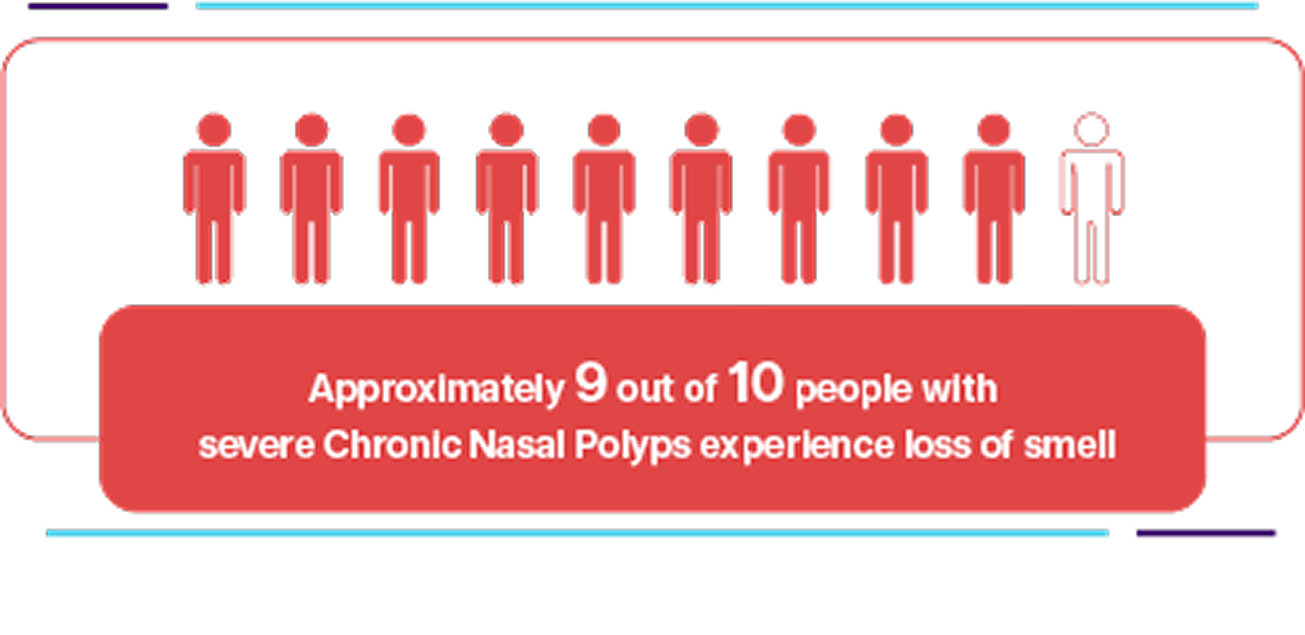
In CRSwNP, small, fleshy growths called nasal polyps form inside your nose because of long-term inflammation. They can partly or fully block your nose, making it hard to breathe.2,4 They block the airflow and prevent scent molecules from reaching the sensory cells high in your nose.1,3 They can also damage the nerves and smell sensors that help to detect different smells.1 If you have Chronic Nasal Polyps symptoms, you may experience a runny nose or nasal congestion along with a reduced or lost sense of smell.4,14

The link between Chronic Nasal Polyps and Type 2 inflammation
Inflammation is your body’s natural way of responding to injury, illness or something it wants to get rid of—like a virus. CRSwNP is commonly caused by a type of long-lasting inflammation called Type 2 inflammation.2,16 This happens when your immune system responds to a trigger but doesn't switch off when it has gone away. The chronic nasal inflammation in your nose and sinuses continue, which can lead to ongoing sinus problems and damage.17,18
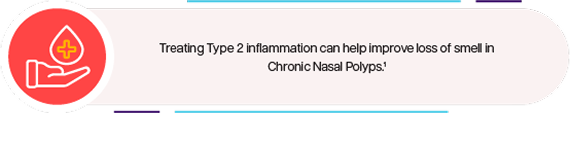
Learn more about Type 2 inflammation in Chronic Nasal Polyps [About Chronic Nasal Polyps/Countries to add country-specific URL].
Getting your sense of smell tested
Many people don’t realize that they have lost their sense of smell until their CRSwNP is already advanced. In fact, it can take months or even years to notice. By then, the chronic nasal inflammation and polyps in your nose may have got worse.7,16
If you have CRSwNP, talk to your doctor to see if they have a way to assess your smell. Some clinics may have the capability to perform smell tests, for example, Scratch & Sniff, VAS scale, or SNOT-22.4
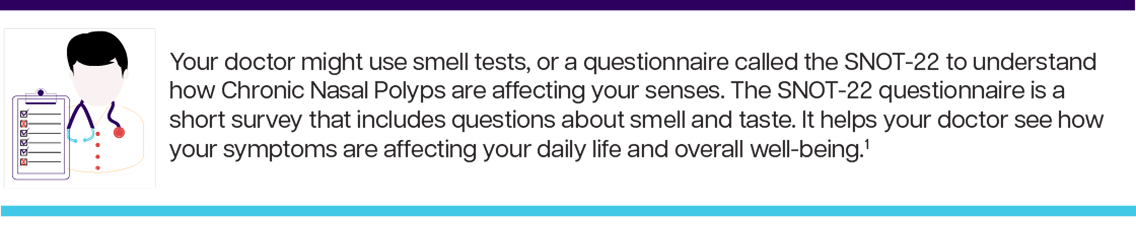
Other common tests include the Sniffin’ Sticks Test and the University of Pennsylvania Smell Identification Test (UPSIT), which check how well a person can detect, recognize, and tell different smells apart.1,3,6,9,10
Taking control of your smell loss

Treatment for CRSwNP aims to relieve nasal polyp symptoms, including loss of smell, and help you feel better in your daily life.18,19 There are different options to manage nasal polyps symptoms and their impact on quality of life, including medications (such as corticosteroids or biologics) and surgery.1,2,14 Understanding your treatment options can help you get the care that's right for you.
Learn more about treatments for Chronic Nasal Polyps [Treatment and management].Key points
- Losing your sense of smell can affect your daily life—it may make food less enjoyable, lower your mood, and impact how you connect with others and the world around you.1,5,11,12
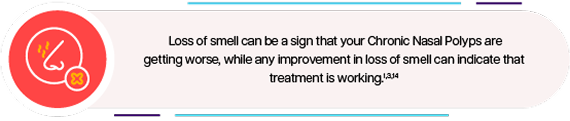
- Loss of smell is a common symptom of CRSwNP and can be one of the first signs that your condition isn't well controlled, even with treatment.1-3,14
- If you are living with CRSwNP, talk to your doctor about getting a smell test4
Actions you can take
- Complete our Chronic Nasal Polyps Symptom Checker[Chronic Nasal Polyps Symptom checker/Countries to add country-specific URL]
- Use our Doctor Discussion Guide to help you prepare for next appointment [Useful tools/Countries to add country-specific URL]
- Find a specialist near you [Countries to add country-specific URL]
References
- Soler ZM, Nash S, Lane AP, et al. Reduced sense of smell in patients with severe chronic rhinosinusitis and its implications for diagnosis and management: a narrative review. Adv Ther. 2024;41(12):4384-4395. doi:10.1007/s12325-024-02984-w
- Lane AP, Mullol J, Hopkins C, et al. Dupilumab improves sense of smell and clinical outcomes in patients with severe chronic rhinosinusitis with nasal polyps with anosmia. Curr Med Res Opin. 2025;41(1):53-59. doi:10.1080/03007995.2024.2434083
- Macchi A, Giorli A, Cantone E, et al. Sense of smell in chronic rhinosinusitis: a multicentric study on 811 patients. Front Allergy. 2023;4:1083964. doi:10.3389/falgy.2023.1083964.
- American College of Allergy, Asthma & Immunology. Chronic rhinosinusitis with nasal polyps. Available at: Chronic rhinosinusitis with nasal polyps. Accessed March 12, 2026.
- Herz RS, Bajec MR. Your money or your sense of smell? A comparative analysis of the sensory and psychological value of olfaction. Brain Sci. 2022;12(3):299. doi:10.3390/brainsci12030299
- Blomkvist A, Hofer M. Olfactory impairment and close social relationships: a narrative review. Chem Senses. 2021;46:bjab037. doi:10.1093/chemse/bjab037
- WHYY. Why don't doctors screen patients for smell loss? Available at: WHYY. Accessed March 12, 2026.
- National Institute on Deafness and Other Communication Disorders. Smell disorders. Available at: Smell-disorders. Accessed March 12, 2026.
- ULCA health. Why your sense of smell is important to your health. Available at: ULCA health. Accessed March 12, 2026.
- News in health. What your nose knows. Available at: Newsinhealth. Accessed March 12, 2026.
- Dekeyser A, Huart C, Hummel T, Hox V. Olfactory loss in rhinosinusitis: mechanisms of loss and recovery. Int J Mol Sci. 2024;25(8):4460. doi:10.3390/ijms25084460
- Elkholi SMA, Abdelwahab MK, Abdelhafeez M. Impact of the smell loss on the quality of life and adopted coping strategies in COVID-19 patients. Eur Arch Otorhinolaryngol. 2021;278(9):3307-3314. doi:10.1007/s00405-020-06575-7
- Miwa T, Furukawa M, Tsukatani T, Costanzo RM, DiNardo LJ, Reiter ER. Impact of olfactory impairment on quality of life and disability. Arch Otolaryngol Head Neck Surg. 2001;127(5):497-503. doi:10.1001/archotol.127.5.497
- Mullol J, Bachert C, Amin N, et al. Olfactory outcomes with dupilumab in chronic rhinosinusitis with nasal polyps. J Allergy Clin Immunol Pract. 2022;10(4):1086-1095.e5. doi:10.1016/j.jaip.2021.09.037
- Luke L, Lee L, Gokani SA, Boak D, Boardman J, Philpott C. Understanding the impact of chronic rhinosinusitis with nasal polyposis on smell and taste: an international patient experience survey. J Clin Med. 2023;12(16):5367. doi:10.3390/jcm12165367
- InformedHealth.org. In brief: What is an inflammation? Institute for Quality and Efficiency in Health Care (IQWiG). Available at: What is an inflammation? Accessed March 12, 2026.
- Allergy & Asthma Network. What is type 2 inflammation? Available at: What is type-2-inflammation. Accessed March 12, 2026.
- InformedHealth.org [Internet]. Cologne, Germany: Institute for Quality and Efficiency in Health Care (IQWiG); 2006. Sinusitis: Learn More – Treating chronic sinusitis. [Updated 2024 Apr 17]. Available at: Sinusitis: Learn More – Treating chronic sinusitis. Accessed March 12, 2026.
- Mayo Clinic. Nasal polyps – Symptoms and causes. Mayo Clinic [Internet]. Available at: Nasal-polyps/symptoms. Accessed March 12, 2026.
